Add one WHERE clause and your vector search can go blind.
In Qdrant's filtered-search benchmark (1M points, default HNSW settings), a filter that kept 1% of the data dropped plain-graph recall@10 to 0.1%. In a separate pgvector test by dbi services, a filter matching 0.5% of rows returned zero rows at the default ef_search of 40.
Neither database is broken. That's just how an HNSW graph behaves when you delete most of its nodes from a query's point of view: the graph turns into islands and the search gets stranded.
That's why "which vector DB is fastest?" is the wrong question. Vendor benchmarks are mostly unfiltered QPS. Your production query is "nearest chunks for this tenant, in this product, updated after this date". The right database is the one that handles your filters, tenancy and ops load at a price you can live with.
Here's how I'd decide between the four that come up most: Pinecone, Weaviate, Qdrant and pgvector. Facts and prices below were checked on 22 October 2026.
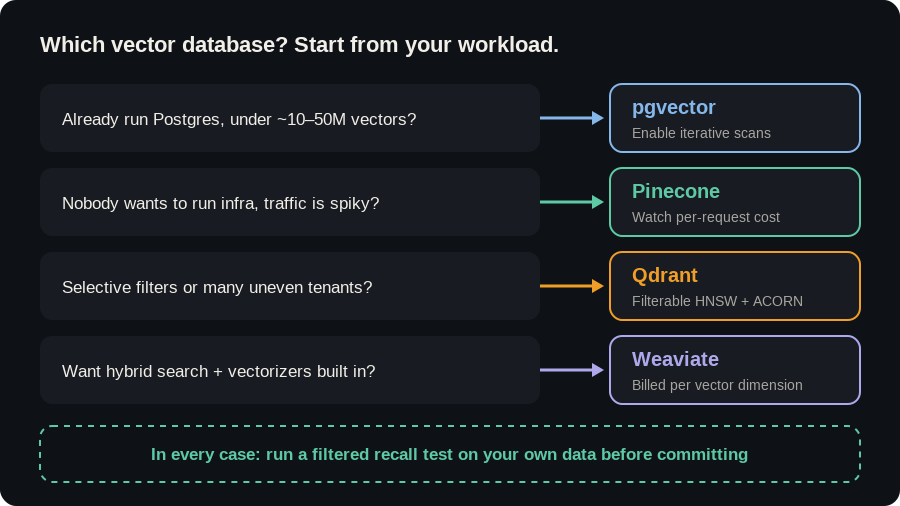
The four questions that actually decide it
Before reading any comparison table, answer these about your workload:
- Do you already run Postgres in production? If yes, a new database is a new on-call surface. That has a cost that never shows up on a pricing page.
- How selective are your filters? Write down your three most common filters and what share of rows each keeps. 50% is easy. 1% is where engines start to differ.
- How many tenants, and how uneven are they? Ten enterprise customers and 50,000 free-tier users need different isolation strategies.
- What's your traffic shape? Bursty and low is a pay-per-request workload. Steady and high is a provisioned-capacity workload.
Your answers map almost directly to a choice.
When each one wins
pgvector: you already run Postgres
pgvector is an extension, not a service. Vectors live next to your rows, so joins, transactions, row-level security and backups all come for free.
What to know in 2026:
- Upgrade now. pgvector 0.8.7 (5 October 2026) fixes a buffer overflow in IVFFlat index builds (CVE-2026-103484). If you're on an older 0.8.x, schedule it.
- Iterative index scans exist but are off by default. Since 0.8.0,
hnsw.iterative_scankeeps scanning until enough rows pass your filter. Without it, selective filters return short or empty results. - Dimension limits are real. HNSW and IVFFlat index
vectorup to 2,000 dimensions andhalfvecup to 4,000. A 3,072-dimension embedding needshalfvec(or an expression index cast to it). - Watch index size. When the HNSW index outgrows
shared_buffers, latency falls off a cliff. That's the point to look at pgvectorscale's DiskANN index or a dedicated engine.
The production-safe filtered query pattern:
BEGIN;
SET LOCAL hnsw.ef_search = 100;              -- stay roughly 40-200
SET LOCAL hnsw.iterative_scan = relaxed_order;
SET LOCAL hnsw.max_scan_tuples = 20000;       -- bound the work
SELECT id, content
FROM chunks
WHERE tenant_id = $1
ORDER BY embedding <=> $2
LIMIT 10;
COMMIT;
Use SET LOCAL inside a transaction. Plain SET leaks across pooled connections.
Wins when: you're on Postgres, under the tens of millions of vectors, and your team would rather tune one database than run two.
Pinecone: you want zero ops
Pinecone is fully managed, and in 2026 it filled two long-standing gaps:
- Dedicated Read Nodes (GA 15 April 2026) give an index provisioned read capacity, billed hourly per node, instead of per request. Pinecone's own customer examples claim 77% to 97% savings versus on-demand at sustained QPS. Those are vendor numbers, but the logic is sound: steady high traffic is cheaper on provisioned capacity.
- BYOC (GA 25 August 2026, AWS, GCP and Azure) runs the data plane in your own cloud account. That removes the most common "our data can't leave our VPC" objection.
- Full-text search (GA 2 September 2026) combines BM25, dense and sparse ranking in one index.
Plans: Starter is free (2 GB), Builder is a flat $20/month, Standard has a $50/month minimum, Enterprise a $500/month minimum.
Wins when: nobody on the team wants to own a database, traffic is spiky, or you need to ship this sprint.
Qdrant: your filters are hard or your tenants are many
Qdrant's whole design leans into filtered search:
- Filterable HNSW adds extra graph edges for indexed payload values, so the graph stays connected under a filter. In their benchmark, a 1% filter went from 0.1% recall@10 on the plain graph to 99.8%.
- ACORN (since 1.16) is an opt-in, per-query mode that checks neighbours of neighbours when direct neighbours fail the filter. It rescued multi-keyword intersections, where a 4% intersection went from 63.7% to 99.9% recall.
- Tiered multitenancy (1.16) lets small tenants share a fallback shard and promotes large ones to dedicated shards without downtime.
- Qdrant Cloud added GPU-accelerated indexing, multi-AZ clusters and audit logging in April 2026. The current release line is 1.19.
The free cloud tier is 1 GB RAM, 0.5 vCPU and 4 GB disk. Paid managed clusters are billed hourly by resources, and there's a Hybrid Cloud option that runs in your infrastructure.
Wins when: filters are selective or combined, you have many uneven tenants, or you want open source you can self-host with a managed option later.
Weaviate: you want search features out of the box
Weaviate's strength is batteries included: native hybrid search (BM25 plus vector), built-in vectorizer modules, multi-tenancy, and now hosted embeddings and a Query Agent on Weaviate Cloud. Releases ship every two months or so. 1.39 landed on 27 August 2026.
Pricing is billed on vector dimensions stored, so you can estimate it before you sign up:
monthly_vector_cost ≈ objects × dimensions × replicas / 1,000,000 × rate
Flex starts at $45/month, with vector dimensions from $0.00465 per million (the exact rate depends on index type, compression and region). Premium starts at $400/month. There's a free tier of 100,000 objects.
Wins when: you want hybrid search, vectorization and multi-tenancy without wiring them together yourself.
The decision table
| If this is true | Start with | Watch out for |
|---|---|---|
| Already on Postgres, under ~10–50M vectors | pgvector | Iterative scans off by default, index outgrowing RAM |
| No one wants to run infra, spiky traffic | Pinecone | Per-request costs at steady high QPS (look at DRN) |
| Selective or combined filters, many tenants | Qdrant | Index build time with filterable HNSW |
| Want hybrid search + vectorization built in | Weaviate | Dimension-based billing with high-dim models |
| Data can't leave your VPC | pgvector, Qdrant (self-host / Hybrid Cloud), Pinecone BYOC | Who carries the pager |
The ~10–50M figure is a rule of thumb, not a hard limit. The real boundary is "does the index still fit in memory on the box I'm willing to pay for".
The test to run before you commit
Don't pick from a blog post, including this one. Spend half a day on this:
- Load a realistic sample, at least 1M vectors with your real metadata.
- Take 200 real queries and attach your three most common filters.
- Compute exact top-10 by brute force over only the rows that pass each filter.
- Compare with what each database returns.
import numpy as np

def exact_topk(q, vecs, ids, mask, k=10):
    v, i = vecs[mask], ids[mask]
    sims = (v @ q) / (np.linalg.norm(v, axis=1) * np.linalg.norm(q))
    return i[np.argsort(-sims)[:k]].tolist()

def recall_at_k(db_ids, exact_ids, k=10):
    return len(set(db_ids[:k]) & set(exact_ids[:k])) / k

# for each filter: record mean recall, p95 latency,
# and how often the DB returned fewer than k rows
Bucket results by filter selectivity (50%, 10%, 1%, 0.1%). One averaged recall number hides exactly the failures you care about. Qdrant's own write-up makes the same recommendation: measure recall per filter shape.
Keep the exit door open
Whatever you pick, make switching cheap later:
- Store the raw text and the embedding model version next to every vector, so you can re-embed and re-index anywhere.
- Keep retrieval behind one interface in your code (
search(query, filters, k)), not vendor SDK calls sprinkled everywhere. - Treat the vector index as rebuildable, not as your source of truth.
Checklist
- Wrote down top 3 filters and their selectivity
- Counted tenants and the size of the biggest one
- Classified traffic as bursty or steady
- Ran the filtered recall test on 1M+ real vectors
- Priced it at 12-month projected volume, not today's
- On pgvector: upgraded to 0.8.7 and enabled iterative scans
- Raw text + model version stored with every vector
The fastest database on an unfiltered benchmark is often not the one that returns the right ten chunks for your tenant. Test with your filters, then decide.
Sources
- Qdrant: Filtered vector search, ACORN and filterable HNSW benchmark
- Qdrant 1.16 release: tiered multitenancy, ACORN, inline storage
- Qdrant pricing
- Qdrant Private Cloud changelog (current 1.19.x line)
- SiliconANGLE: Qdrant Cloud launches GPU indexing, multi-AZ and audit logging (April 2026)
- PostgreSQL.org: pgvector 0.8.7 released
- dbi services: pgvector, a guide for DBA, Part 2: Indexes (March 2026)
- Pinecone pricing
- Pinecone 2026 release notes
- Blocks and Files: Pinecone Dedicated Read Nodes (April 2026)
- Weaviate pricing
- Weaviate Cloud pricing update
- Weaviate blog archive (release history)