"SEO is dying" is half right. The half that's right: clicks from Google's AI surfaces are down, hard. Ahrefs re-ran its study on December 2025 data and found that when an AI Overview shows up, the top-ranking page gets about 58% fewer clicks, up from a 34.5% drop in its April 2025 study. Pew's panel of real users saw the same shape: people clicked a regular result in 8% of visits with an AI summary, versus 15% without one.
The half that's wrong: search traffic didn't go anywhere. Cloudflare Radar data for 2026 still puts Google at roughly 88-89% of all search referrals, with ChatGPT under 1%. What changed is who gets the clicks. Seer Interactive found that pages cited inside an AI Overview got about 2.1% CTR, pages on the same results page that weren't cited got about 0.9%, and searches with no AI Overview sat around 3.3%.
So the game isn't "rank #1" anymore. It's "be the document the model picks." That's a retrieval problem, and AI engineers are better placed to solve it than most marketers.
Takeaway: open Search Console's new Generative AI report (impressions in AI Overviews and AI Mode, data from May 18, 2026) and sort your pages by AI impressions. That's your baseline before you change anything.
AI search is a RAG pipeline you don't control
Google said it plainly in its May 15, 2026 guide: its generative features use retrieval-augmented generation and query fan-out to pull content from the Search index, on top of the same core ranking and quality systems. Its headline is that optimizing for AI search is still SEO. ChatGPT, Claude and Perplexity run their own variants, but the shape is the same.
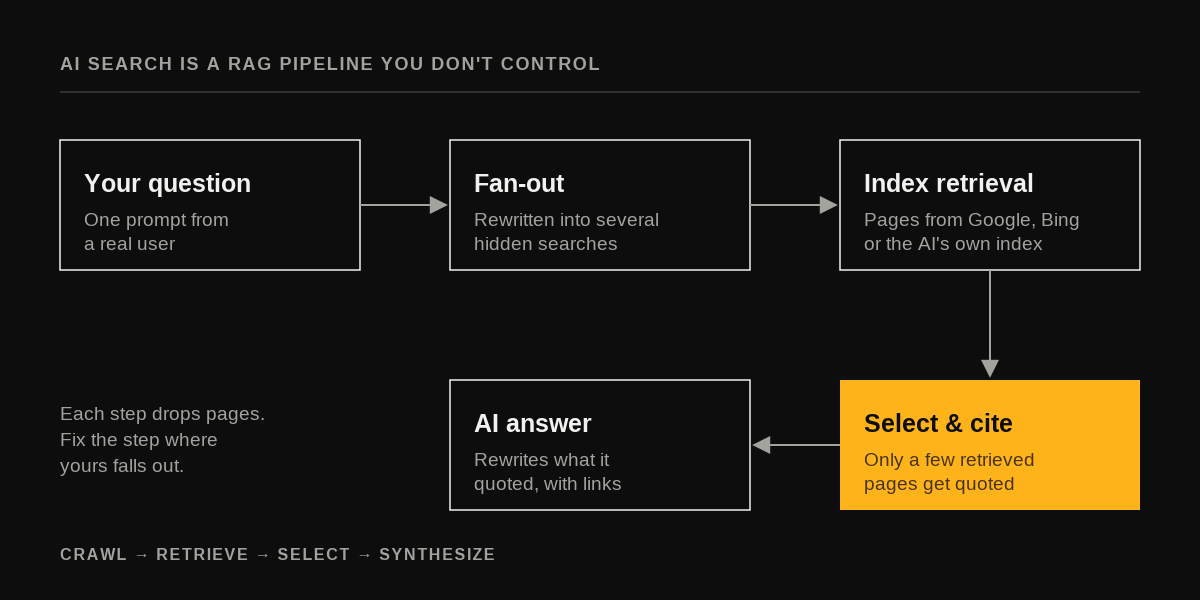
If you've debugged a RAG system, you know each stage fails differently. Here's the map:
| Stage | How your page loses | What to fix |
|---|---|---|
| Crawl / index | Search bot blocked, page not in the index the engine uses | robots.txt split, Bing + Google indexing |
| Fan-out retrieval | You rank for the head term, not the sub-questions | Cover the sub-questions, not just the keyword |
| Select & cite | Retrieved, but nothing quotable | Self-contained passages with numbers and sources |
| Synthesis | Cited, but paraphrased wrong | Unambiguous claims, named entities, dates |
The rest of this post is one section per row.
Stage 1: let the search bots in, decide on training separately
Most AI vendors now split their crawlers by job: one for training, one for building a search index, one for fetching a page when a user asks. Blocking the training bot doesn't block search, and the reverse is a common mistake: a blanket block that quietly removes you from AI answers.
A robots.txt that allows AI search and user fetches but opts out of training:
# Search index + live user fetches: allow
User-agent: OAI-SearchBot
User-agent: ChatGPT-User
User-agent: Claude-SearchBot
User-agent: Claude-User
User-agent: PerplexityBot
User-agent: Perplexity-User
Allow: /

# Model training: your call
User-agent: GPTBot
User-agent: ClaudeBot
Disallow: /
Google is the exception. AI Overviews and AI Mode draw from the normal Search index, so there's no separate AI search bot to allow. If Googlebot can index you, you're eligible.
Two more checks. ChatGPT search leans on Bing's index (Seer reported most ChatGPT citations match Bing's top results), so verify your site in Bing Webmaster Tools, not only Search Console. And check your logs to confirm the bots actually come:
grep -oE "OAI-SearchBot|ChatGPT-User|Claude-SearchBot|Claude-User|PerplexityBot|GPTBot|ClaudeBot" access.log \
  | sort | uniq -c | sort -rn
Takeaway: if a search bot shows zero hits for a month, start debugging there, before touching content.
Stage 2: retrieval happens on the fan-out, not your keyword
The model rewrites one prompt into several searches. AirOps analyzed 548,534 pages ChatGPT retrieved across 15,000 prompts: 89.6% of prompts triggered two or more extra searches, 32.9% of citations came only from those follow-up searches, and 95% of the fan-out queries had zero search volume in keyword tools. Only about 15% of retrieved pages made it into the answer as citations.
How often a model searches at all moves with each release. Ahrefs looked at 66.6 million free, logged-out ChatGPT responses from August-September 2026 and found only 14.4% ran a web search. So treat any single study as a snapshot, not a constant.
What this means in practice: keyword research misses most of the queries that decide citations. You need the sub-questions. Two ways to get them:
- Ask the model. Paste your target prompt and add:
Before answering, list the exact web searches you would run to answer this,
one per line. Don't answer the question.
Run it in ChatGPT, Gemini and Perplexity. Each one splits the prompt its own way.
- Mine Search Console for prompt-shaped queries. Long, question-like queries are the closest thing to fan-out you can see. In the Performance report, filter queries with a custom regex such as (my starting point, tune it):
^(how|what|why|which|when|can|should|is|does|do)\b.{30,}
Takeaway: for each page, write down the 5-8 sub-questions it should answer, and check each one is answered in its own section.
Stage 3: write passages a model can lift
Selection is where most retrieved pages lose. The original GEO paper (Aggarwal et al., KDD 2024) tested nine content edits on a 10,000-query benchmark. Adding quotations, statistics and cited sources each raised visibility in generated answers by roughly 30-40%, while keyword stuffing did worse than doing nothing. Lower-ranked pages gained the most: citing sources lifted a page in position 5 by about 115%.
Read that with care. The main experiments ran on a simulated engine built on GPT-3.5 in 2023-24, and engines have changed a lot since. But the mechanism matches what any reranker rewards: dense, specific, verifiable passages.
A passage checklist I'd apply to every H2:
- First sentence answers the section's question on its own, with no "as mentioned above"
- Numbers carry a source and a date ("Ahrefs, Dec 2025 data"), not "many teams"
- Name the thing: product, version, standard, date. Models resolve entities, not vibes
- One claim per paragraph, so a 2-3 sentence chunk stands alone
- A visible "last updated" date on pages you refresh
Takeaway: take your top-traffic page, run the checklist on each section, and fix the first sentence of every H2. That's an hour of work.
What to skip
A lot of GEO advice is cargo cult. Two things to drop:
| Tactic | Verdict | Why |
|---|---|---|
| llms.txt | Skip for search | Ahrefs found 97% of llms.txt files got zero AI crawler requests in May 2026; Google says it doesn't use it |
| AI-only rewrites, special schema, Markdown copies | Skip for Google | Google's guide says none of these are needed for its AI features |
| robots.txt bot split | Do | Directly controls index eligibility |
| Bing Webmaster Tools | Do | Bing's index feeds Copilot and, reportedly, ChatGPT search |
| Fact-dense, sourced passages | Do | Backed by the GEO paper and by how rerankers work |
llms.txt can still help an agent navigate your docs once it's there. It just isn't a ranking lever.
Measure it like an eval, not a vibe
You wouldn't ship a RAG change without an eval. Same here. Three signals, all available today:
- Google Search Console, Generative AI report. Impressions in AI Overviews and AI Mode. No clicks or queries yet.
- Bing Webmaster Tools, AI Performance. Citation counts, cited pages and the grounding queries behind them, for Copilot and Bing's AI answers. It doesn't cover ChatGPT.
- GA4 referral segment. A session source regex like:
chatgpt\.com|chat\.openai\.com|perplexity\.ai|claude\.ai|gemini\.google\.com|copilot\.microsoft\.com
Then add the one nobody gives you for free: a fixed prompt panel. 20 prompts your buyers actually ask, run monthly across 3-4 engines, logging whether you're cited and which URL. Store it like eval results: prompt, engine, date, cited (y/n), URL, competitor cited.
Takeaway: start the prompt panel this week. Ten prompts in a spreadsheet beats any dashboard you don't have yet.
The 30-minute audit
- Search Console Generative AI report: note your top 10 pages by AI impressions
- robots.txt: search bots allowed, training bots decided on purpose
- Logs: each search bot hit you in the last 30 days
- Site verified in Bing Webmaster Tools
- One key page: list its fan-out sub-questions, confirm each has a section
- Same page: first sentence of every H2 answers on its own, every number sourced and dated
- GA4 AI referral segment saved
- 10-prompt panel created, first run logged
SEO isn't dying. It's becoming retrieval, and retrieval is our home turf.
Sources
- Ahrefs, "AI Overviews Reduce Clicks by 58%" (Dec 2025 data): https://ahrefs.com/blog/ai-overviews-reduce-clicks-update
- The Next Web on Pew Research click rates and Google's May 2026 AI Overviews updates: https://thenextweb.com/news/google-ai-overviews-publisher-links-search-traffic
- Search Engine Land, Seer Interactive AI Overviews CTR study (Apr 2026): https://searchengineland.com/google-ai-overviews-ctr-recovery-study-475566
- TechnologyChecker, search referral share from Cloudflare Radar (Q3 2026): https://technologychecker.io/blog/search-engine-market-share
- Google Search Central, "A new resource for optimizing for generative AI in Google Search" (May 15, 2026): https://developers.google.com/search/blog/2026/05/a-new-resource-for-optimizing
- Semrush summary of Google's generative AI guide: https://www.semrush.com/blog/google-publishes-generative-ai-search-guide/
- Google Search Central, "Introducing Search Generative AI performance reports in Search Console" (Jun 3, 2026): https://developers.google.com/search/blog/2026/06/gen-ai-performance-reports
- Parse, robots.txt for AI crawlers (training vs search vs user agents): https://www.parse.gl/blog/robots-txt-ai-crawlers-configuration
- Parse, Bing rankings and ChatGPT citations (Seer data): https://www.parse.gl/blog/bing-rankings-chatgpt-visibility
- Search Engine Land coverage of the AirOps ChatGPT citation study, via Mean CEO: https://blog.mean.ceo/?p=6965
- Relevant Audience on Ahrefs' GPT-5.6 fan-out study (Oct 2026): https://www.relevantaudience.com/geo/chatgpt-query-fan-out-citations-ahrefs-study/
- Aggarwal et al., "GEO: Generative Engine Optimization," KDD 2024: https://arxiv.org/abs/2311.09735
- Konabayev, GEO statistics from the KDD paper (method notes): https://konabayev.com/blog/geo-statistics-2026/
- Project LLMs.txt, adoption and Ahrefs crawl data (2026): https://projectllmstxt.com/blog/llms-txt-adoption-2026
- Practical Ecommerce, Bing AI Performance report: https://www.practicalecommerce.com/bings-improved-ai-performance-section
- Adobe Experience League, Bing AI Performance report coverage: https://experienceleague.adobe.com/en/docs/brand-visibility-learn/tutorials/measurement/bing-webmaster-tools-ai-performance-report