Four frontier models score 52 on the Artificial Analysis Intelligence Index right now.
- GPT-6.1 Sol (max effort): $0.72 per task
- Claude Sonnet 5.5 (xhigh): $2.01 per task
- GPT-6 Astra (xhigh): $2.31 per task
- Meta Muse Wonder (max): $4.54 per task
Same score. A 6.3x spread in what you actually pay.
It gets stranger. GPT-6.1 Sol and Sonnet 5.5 have the same list price, $2 in and $10 out per million tokens. They still land 2.8x apart per task, because one burns far more tokens to reach the same answer.
So the question "which model is best?" has no useful answer. The useful one is: which model and effort level solves my task, at my latency budget, for the least money? Here's how I'd answer it in October 2026. All prices and scores below were checked on 26 October 2026.
The October 2026 lineup
Numbers from the vendors' pricing pages and the Artificial Analysis (AA) leaderboard. "Best index" is the model's top effort setting.
| Model | List price (in / out per 1M) | Best AA index | Cost per task at that setting |
|---|---|---|---|
| Claude Opus 5.5 | $4 / $20 | 58 | $5.98 |
| Claude Sonnet 5.5 | $2 / $10 | 56 | $5.46 |
| Kimi K3.1 Pro | $2 / $10 | 55 | $2.11 |
| Gemini 4 Argon | $2 / $10 (intro) | 53 | $1.99 |
| GPT-6 Astra | $10 / $50 | 53 | $3.26 |
| Claude Fable 5.1 | $10 / $50 | 53 | $7.63 |
| GPT-6.1 Sol | $2 / $10 | 52 | $0.72 |
| DeepSeek V4.1 Flash | $0.15 / $0.60 off-peak | 45 | $0.26 |
| Claude Haiku 5.5 | $0.10 / $0.50 (≤100K prompt) | 43 | $0.21 |
| Gemini 3.8 Flash | $0.75 / $3.75 (intro) | 41 | $1.24 |
| GPT-6 Luna | $0.10 / $0.50 | 38 | $0.07 |
Two things jump out.
First, list price predicts almost nothing. GPT-6 Astra costs 5x Sol per token but only about 4.5x per task at max effort. Kimi K3.1 Pro, Gemini 4 Argon and GPT-6.1 Sol share a $2/$10 sticker and still spread from $0.72 to $2.11.
Second, the small tier is not uniform. Haiku 5.5 at xhigh and Gemini 3.8 Flash at high both score 41. One costs $0.12 per task, the other $1.24.
Takeaway: never shortlist from the pricing page. Shortlist from cost per task at the quality you need.
The effort knob matters more than the vendor
Every frontier model now ships with a reasoning effort setting. That setting moves quality, cost and latency more than switching vendors does. Here's Claude Opus 5.5 across its range:
| Effort | AA index | Cost per task | Time to first chunk |
|---|---|---|---|
| low | 42 | $0.55 | 7.7 s |
| medium | 51 | $1.34 | 17.1 s |
| high | 54 | $1.82 | 31.3 s |
| xhigh | 56 | $3.46 | 119 s |
| max | 58 | $5.98 | 694 s |
Going from high to max buys 4 index points for 3.3x the cost and 22x the wait. GPT-6.1 Sol shows the same shape: medium scores 48 at $0.21 with a 4.4-second first chunk, max scores 52 at $0.72 with 251 seconds.
That latency column is the one people skip. A 4-minute time to first chunk is fine for an overnight code migration. It's unusable in a support chat.
Diagnostic step: before you switch vendors because "the model isn't smart enough", rerun your eval one effort level up on the model you have. Before you switch because "it's too slow or expensive", rerun one level down. Most of the time, the fix is a config change, not a migration.
Pricing traps to check before you commit
The sticker price has fine print, and some of it has an expiry date.
- Intro pricing ends. Gemini 4 Argon is $2/$10 through 30 November 2026, then $4/$20 from 1 December. Gemini 3.8 Flash doubles on 1 January 2027. Any cost model built this month needs the post-promo rate.
- Long prompts change the tier. Claude Haiku 5.5 is $0.10/$0.50 up to 100K-token prompts and $0.50/$2.50 above that. A RAG pipeline that stuffs context crosses that line quietly.
- Caching is the biggest discount on the page. Cached input is $0.10 on GPT-6.1 Sol versus $2 uncached, and $0.20 versus $4 on Opus 5.5. A stable system prompt plus tool definitions should always be cached.
- Batch halves the bill. Both Anthropic and OpenAI list 50% off for batch. Anything that doesn't need an answer in seconds (evals, enrichment, backfills) belongs there.
- Regional endpoints cost more. Anthropic's US-only inference is 1.1x. OpenAI's data-residency endpoints carry a 10% uplift. If you have residency requirements, price them in from day one.
- Thinking tokens are output tokens. Google's pricing page says it plainly: output price includes thinking. High effort on a $10-output model is where budgets go.
Takeaway: price your shortlist at the rate you'll pay in three months, with your real prompt sizes and cache hit rate.
Build your own benchmark in an afternoon
Public indexes are a good filter. They are not your workload. AA's index is weighted across agents, coding, scientific reasoning and general tasks. Your product might be 90% invoice extraction.
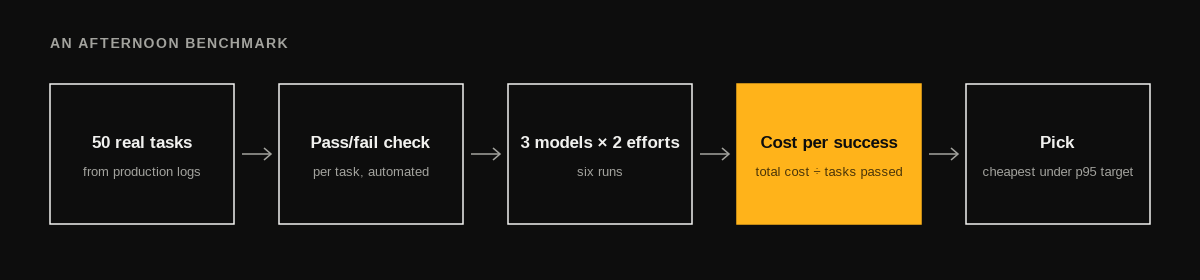
Here's the harness I'd run. Pick 50 real tasks from production logs, each with a pass/fail check you can automate (exact match, JSON schema, unit test, or an LLM judge with a rubric). Then:
import time, statistics as st

# USD per 1M tokens, checked 26 Oct 2026. Update before every run.
PRICES = {
    "gpt-6.1-sol":       {"in": 2.00, "cached": 0.10, "out": 10.00},
    "claude-sonnet-5-5": {"in": 2.00, "cached": 0.10, "out": 10.00},
    "claude-haiku-5-5":  {"in": 0.10, "cached": 0.01, "out": 0.50},
    "gemini-4-argon":    {"in": 4.00, "cached": None, "out": 20.00},  # post-Dec 1 rate
}

def run(model, effort, tasks, call_model, check):
    rows = []
    for t in tasks:
        t0 = time.perf_counter()
        # call_model wraps your SDK and returns text, usage dict, first-token time
        out, usage, ttft = call_model(model, effort, t["prompt"])
        p = PRICES[model]
        cost = (usage["input"] * p["in"]
                + usage.get("cached", 0) * (p["cached"] or p["in"])
                + usage["output"] * p["out"]) / 1e6  # output includes thinking
        rows.append({"ok": check(t, out), "cost": cost, "ttft": ttft,
                     "total": time.perf_counter() - t0})
    passed = sum(r["ok"] for r in rows)
    return {
        "model": model, "effort": effort,
        "pass_rate": passed / len(rows),
        "cost_per_success": sum(r["cost"] for r in rows) / max(passed, 1),
        "p50_ttft": st.median(r["ttft"] for r in rows),
        "p95_total": st.quantiles([r["total"] for r in rows], n=20)[18],
    }
Run three models at two effort levels each. That's six rows and a few dollars.
The metric that decides it is cost per successful task, not cost per call. A model that's half the price but fails twice as often costs the same, plus the cost of the failures reaching users.
Rules that keep it honest:
- Use real tasks, not ones you wrote to test the model. Hand-written tasks are too clean.
- Freeze the task set and version it. Rerun it whenever a vendor ships a new model.
- Read 10 failures per model before you trust the pass rate. Graders have bugs too.
- Record p95 latency, not just the average. Users feel the tail.
A starting shortlist by workload
Illustrative, not a verdict. These are the rows I'd put into the harness first, based on the AA numbers above.
| Workload | Constraint | Start testing with |
|---|---|---|
| High-volume extraction, classification, routing | Cents per thousand calls | GPT-6 Luna, Claude Haiku 5.5, DeepSeek V4.1 Flash |
| Interactive chat and agents | First chunk under ~5 s | GPT-6.1 Sol medium, GPT-6 Astra medium, Sonnet 5.5 medium |
| Hard coding and multi-step agents, offline | Quality first, minutes are fine | Opus 5.5 high or xhigh, Kimi K3.1 Pro, GPT-6.1 Sol max |
| Cost-capped "smart enough" default | Best index per dollar | GPT-6.1 Sol, Gemini 4 Argon (at the Dec 1 price) |
If you need to self-host, add rows from models that publish weights: DeepSeek V4.1 Flash ships with a Hugging Face model card, and MiniMax M3.1 Flash (AA index 43, $0.22 per task) released weights on 23 October. Check each licence for your use case.
The checklist
- Shortlisted from cost per task, not price per token
- Tested each model at two effort levels
- Priced at post-promo rates and real prompt sizes
- Caching on for system prompt and tools; batch for anything offline
- 50 real tasks with automated checks, versioned
- Decided on cost per successful task and p95 latency
- Calendar reminder to rerun when a vendor ships a new model
The leaderboard tells you who's in the race. Your own 50 tasks tell you who wins it for you.
Sources
- Artificial Analysis: LLM leaderboard (intelligence, cost per task, speed, latency)
- Artificial Analysis: Intelligence Index methodology
- Claude pricing (Anthropic)
- OpenAI API pricing
- Gemini API pricing (Google)
- October 2026 AI model updates (DeepSeek, Kimi, Meta pricing roundup)
- BenchLM: Frontier AI models ranking, October 2026