If you learned the Model Context Protocol in 2025, part of your mental model is out of date.
On July 28, 2026, the maintainers shipped a new revision of the spec that retired the initialize handshake and the Mcp-Session-Id header. MCP went from a stateful, connection-heavy protocol to a stateless request/response one. Most tutorials, including plenty of recent ones, still describe the old shape.
This is the explainer I'd want to hand a senior engineer: what MCP is, what a call looks like on the wire today, what changed, where it fits next to function calling and REST, and the security problems you inherit the moment you install a server.
The problem MCP solves
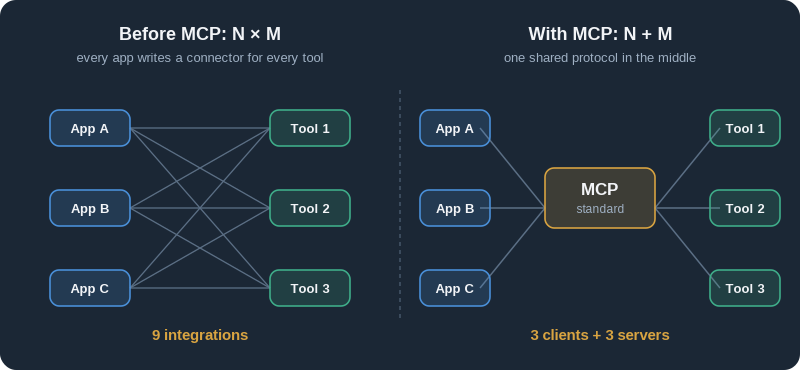
Before MCP, every AI app wrote its own connector to every tool. Three apps and three tools meant nine integrations, and each new app or tool multiplied the work.
MCP is the shared protocol that turns N×M into N+M. A tool owner writes one server. Any MCP-capable client can use it. If you've worked with the Language Server Protocol, the idea is the same: standardize the boundary so the two sides stop caring about each other's internals.
The three roles
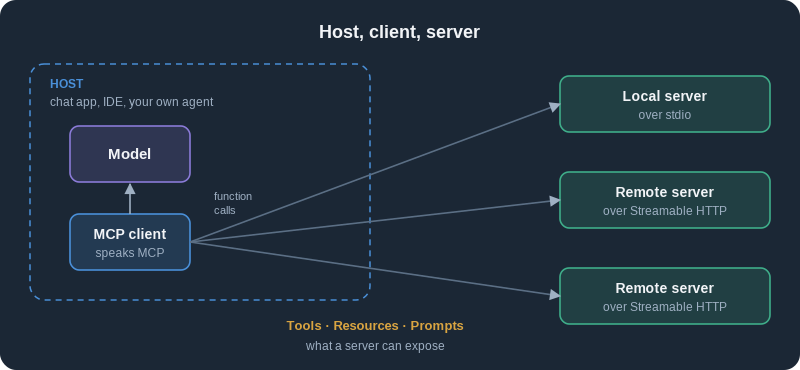
- Host: the application the user is in. A chat app, an IDE, your own agent.
- Client: the connector inside the host that speaks MCP to a server.
- Server: the program that exposes capabilities, either locally over stdio or remotely over Streamable HTTP.
What a server exposes
Three primitives, each with a different owner:
| Primitive | What it is | Who controls it |
|---|---|---|
| Tools | Actions the model can call | The model |
| Resources | Data the app can read | The application |
| Prompts | Reusable templates | The user |
Most servers in practice are tools-only. That's fine, but knowing the other two exist stops you from stuffing everything into tool calls.
What a call looks like in 2026
Under the new spec, every request is self-describing. There's no handshake. The protocol version, client identity, and capabilities travel with each request, and the method and tool name are mirrored into HTTP headers:
POST /mcp HTTP/1.1
MCP-Protocol-Version: 2026-07-28
Mcp-Method: tools/call
Mcp-Name: get_invoice

{"jsonrpc":"2.0","id":7,"method":"tools/call",
 "params":{"name":"get_invoice","arguments":{"invoice_id":"INV-1042"},
 "_meta":{"io.modelcontextprotocol/clientInfo":{"name":"my-agent","version":"0.3.1"}}}}
If a client wants to learn a server's capabilities up front, there's an optional server/discover call. It's not required.
What changed in 2026-07-28
This is the part most explainers miss.
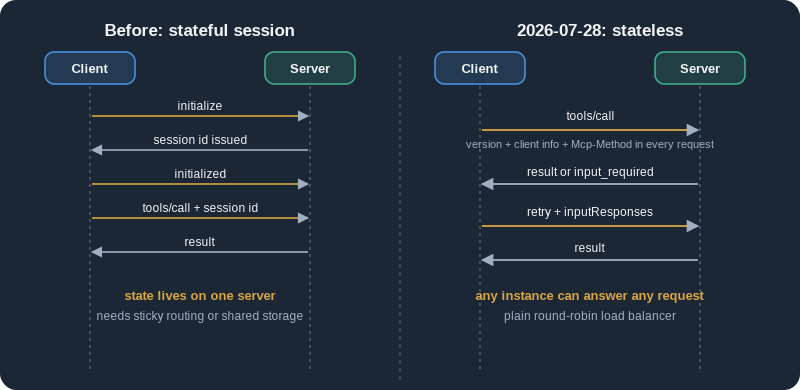
1. A stateless core. No handshake, no protocol-level session. Any request can land on any server instance behind a plain round-robin load balancer, with no shared storage. If your tools genuinely need state, mint an explicit handle from a tool and have the model pass it back as an argument. The maintainers found that works better than hiding session state in the transport, because the model can see the handle.
2. Multi Round-Trip Requests (MRTR). Servers used to ask the user for input mid-call over a held-open stream. Now the server returns resultType: "input_required" with the questions, and the client retries the original call with the answers in inputResponses. Supabase's team pointed out that this is what finally lets a stateless server confirm something like the cost of a new project before acting.
3. Header-based routing. Streamable HTTP requests must include Mcp-Method and Mcp-Name, so gateways, rate limiters, and WAFs can route and meter without parsing JSON bodies.
4. Cacheable lists. tools/list, prompts/list, resources/list, and resources/read responses carry ttlMs and cacheScope, plus a deterministic order. Clients can cache tool catalogs and keep upstream prompt caches stable.
5. Auth hardening. Clients must validate the iss parameter (RFC 9207) before redeeming an authorization code, which closes an authorization-server mix-up hole. Client credentials are bound to the issuer that minted them. Dynamic Client Registration is formally deprecated in favor of Client ID Metadata Documents (CIMD).
6. A real extensions framework. Tasks (long-running, pollable operations) moved out of the experimental core into an extension, alongside MCP Apps and Enterprise Managed Authorization.
7. Deprecations with a clock. Roots, Sampling, and Logging are deprecated, as is the legacy HTTP+SSE transport. They keep working for at least twelve months, which is now the formal minimum deprecation window. New code shouldn't adopt them.
The cost is migration work, especially if you depended on session identifiers. All four Tier 1 SDKs (TypeScript, Python, Go, C#) already speak the new version.
MCP vs function calling vs REST
These aren't competitors. They sit at different layers.
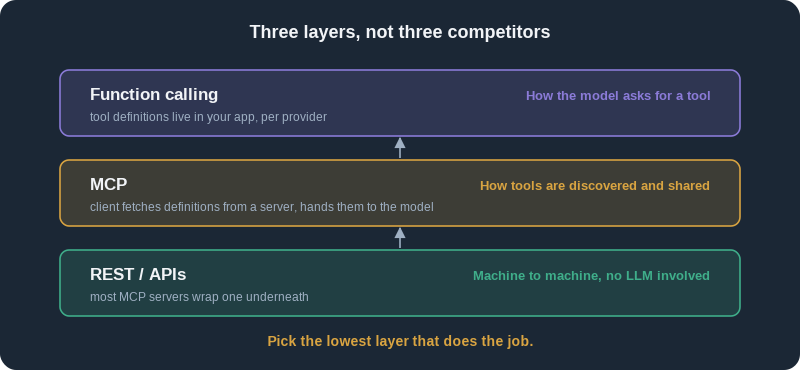
- Function calling is how a model asks for a tool. The tool definitions live in your application code, per provider.
- MCP is how tools get discovered and shared. A client fetches definitions from a server and hands them to the model through function calling, then sends the chosen call back to the server.
- REST is machine-to-machine with no LLM in the loop. Most MCP servers wrap a REST API underneath.
Rule of thumb: one app, one model, a handful of tools? Plain function calling is simpler. A capability you want many clients to use? Build an MCP server. No model involved? Use the API.
Adoption: this is infrastructure now
In December 2025, Anthropic donated MCP to the Linux Foundation's new Agentic AI Foundation, alongside Block's goose and OpenAI's AGENTS.md. That moved governance to a neutral home.
On the numbers, the maintainers report close to half a billion SDK downloads a month across the Tier 1 SDKs, and both the TypeScript and Python SDKs have passed one billion total downloads. The official registry listed 39,238 servers as of October 4, 2026, per a third-party census reading its public API.
Security: the part you can't skip
Installing an MCP server means putting someone else's text into your model's context. That creates attack classes ordinary scanners miss:
- Tool poisoning: malicious instructions hidden in a tool's description or schema. Invisible to the user, visible to the model.
- Rug pulls: a server changes a tool definition after you approved it.
- Cross-server tool shadowing: one server's tool descriptions influence how the model uses another server's tools.
OWASP now publishes an MCP Top 10, and a March 2026 study of seven popular MCP clients found wide gaps in how well they defend against tool poisoning. Your client matters as much as your server.
What I'd do by default:
- Review tool descriptions before enabling a server, and pin versions.
- Re-check descriptions when a server updates.
- Give every token the minimum scope it needs.
- Treat tool output as untrusted input, not just descriptions.
- Require user confirmation for destructive or expensive actions. MRTR makes this practical even for stateless servers.
- Only install servers you'd be comfortable installing as code.
When not to use MCP
- A script that calls one or two APIs. Call them directly.
- A single-model chatbot with three tools. Function calling is less machinery.
- Anywhere tool descriptions would flood the context window. Every tool you expose costs tokens on every request, so keep catalogs small and narrow.
If you're building a server this quarter
- Target
2026-07-28and use a Tier 1 SDK. - Design for stateless by default; use explicit handles for state.
- Use CIMD, not Dynamic Client Registration.
- Don't build on Roots, Sampling, or Logging.
- Set sensible
ttlMsvalues on your list responses. - Keep each tool narrow, well described, and honest about side effects.
MCP stopped being a clever integration trick and became web infrastructure: stateless, cacheable, routable. The habits that go with that, least privilege, input validation, and supply-chain care, are the same ones you already apply to the rest of your stack.
I write about ML engineering and production AI systems at muaazdev.com, three posts a week. Next up: why RAG systems hallucinate, and how to fix retrieval before blaming the model.
Sources
- The 2026-07-28 Specification, MCP blog
- Scaling AI agent infrastructure with the MCP stateless updates, Google Developers Blog
- Linux Foundation launches the Agentic AI Foundation, WorkOS
- MCP and A2A adoption census, Gravity
- Are AI-assisted development tools immune to prompt injection? (arXiv 2603.21642)
- Tool poisoning, rug pulls and the MCP attack classes conventional scanners miss, SoftwareSeni
- MCP vs function calling, Scalar